She Admired Her Mentor. Then Judged Herself for the Same Behavior.
The Double Standards We Hold for Ourselves
Do you admire others for things you criticize yourself for?
Maria participated in my Peak Resilience Accelerator that I run for internal teams.
As a woman in technology, she worked primarily with men.
She frequently second-guessed herself after conversations.
Over-analyzing remarks.
Doubting her competence.
This pattern persisted even when evidence showed she was doing exceptionally well.
The Fear Before Every Presentation
Ahead of an important presentation, Maria felt on-edge.
She feared being asked questions she couldn't answer.
In her senior technical role, she believed she needed to know everything.
I asked her to think of a time when her mentor, Sinead, had been asked something at a meeting that she didn't know.
Maria smiled immediately.
What Her Mentor Actually Said
"Oh, Sinead just says: 'That's a great question. While I don't have the details to hand, I could get someone on my team to look into it. I wouldn't want to give you bad information.'"
I posed a simple question:
How would you feel if you saw the behavior you fear showing yourself in someone you respect?
The Double Standard She Couldn't See
Maria didn't hesitate.
She admired Sinead enormously - everyone did!
She didn't view her response as failure.
She saw it as smart leadership.
She laughed at the idea of judging her mentor harshly.
"Sinead can't be expected to know all the details. That's why she has a team!"
The Lightbulb Moment
Then it clicked.
Maria realized she too had a capable team.
"That's why it's called 'teamwork,'" she said.
"She needs to rely on them. And given how senior Sinead is now, it clearly works!"
Maria valued Sinead deeply.
In fact, in earlier sessions - something we discussed, Maria admitted she might have left the organization without role models like her.
When I reminded her of that conversation, the lightbulb grew even brighter.
What Changed for Maria
If she wouldn't expect perfection from someone she admired, why demand it of herself?
This is the essence of overcoming self-doubt at work.
Recognizing when your inner critic sets standards no one else would expect you to meet.
So why should you?
Ready to Ease Your Impossible Standards?
Email me at suzanne@doylemorris.com for a complimentary chemistry call.
We'll explore your biggest challenge and whether a 12-month coaching partnership makes sense for you.
Most of my clients are employer-funded.
Yes, your company will likely pay for this and I can help you through that goal.
Learn more: www.suzannedoylemorris.com
About Dr. Suzanne Doyle-Morris
Dr. Suzanne Doyle-Morris is an ICF Master Certified Coach (MCC) with a PhD from the University of Cambridge focusing on women in Engineering.
For 25 years, she's coached accomplished women in STEM as they advance to senior leadership.
She's the author of three books: "Beyond the Boys' Club: Strategies for Achieving Career Success as a Woman Working in a Male Dominated Field," "The Con Job: Getting Ahead for Competence in a World Obsessed with Confidence," and "Female Breadwinners: How They Make Relationships Work and Why they are Future of the Modern Workforce."
80% of her clients secure promotions or stretch roles within 12 months.
Not because she gives advice, but because she asks the right questions.
Welcome to my blog

I'm Dr Suzanne Doyle‑Morris and I support woman working in STEM. Whether you’re seeking your next promotion, aiming for leadership, or simply looking to make your mark, this blog is created for you: the ambitious woman in STEM ready to advance and succeed on her own terms.
Blog Categories
FREE GUIDE
The Women in Tech Promotion Playbook
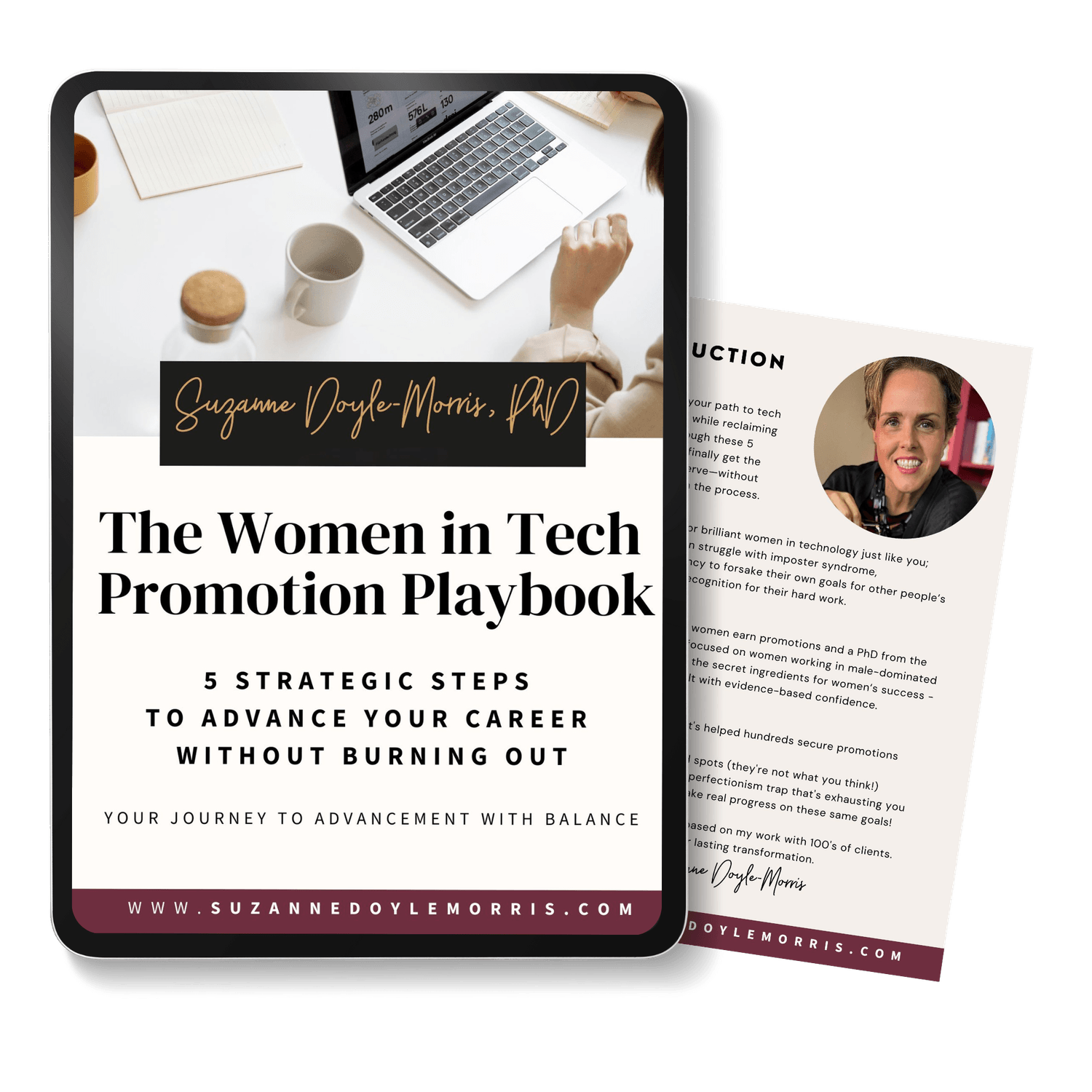
Your roadmap to advancement with balance.
The Women in Tech Promotion Playbook is a practical, evidence-based guide designed for ambitious women in STEM who want to advance their careers without burning out. Drawing on over 25 years of coaching and research, I outline five strategic steps that help women move from being overworked and under-recognised to confident, visible leaders.
Latest on the blog
The Women in Tech Promotion Playbook
Your roadmap to advancement with balance
The Women in Tech Promotion Playbook is a practical, evidence-based guide designed for ambitious women in STEM who want to advance their careers without burning out. Drawing on over 25 years of coaching and research, I outline five strategic steps that help women move from being overworked and under recognised to confident, visible leaders.